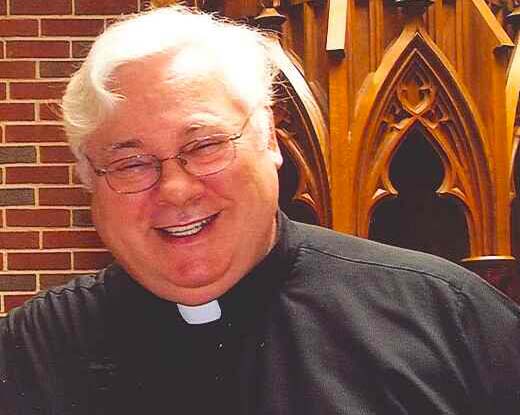
Fr.Thomas Durant - Pastor
A Prayer for April
Grant that what is of heaven may be revealed on earth, that we may rejoice in the good and beautiful things you give to all people.
Our Father, reveal what is of heaven, and free people from their sin and darkness so that at last they recognize your glory.
Strengthen our hope for this goal.

|
|
Sign up on WeShare here - St. Paul's Church
DONATE TO PAYPAYL GIVING FUND FOR YOUR WEEKLY DONATIONS AT ST. PAUL'S CHURCH follow the link below.
https://www.paypal.com/US/fundraiser/charity/4222746
OR USE YOUR CAMERA TO SCAN THE BARCODE.

Sunday April 17th - Fourth Sunday of Easter: The Voice of the Caring Shepherd
I read an interesting story this week about a pop quiz that was given to a new class of nursing students in the first year of their training. Most of the students did well on the quiz until they came to the last question, which they all left blank. That question was, "What is the name of the woman you see every morning who cleans the school?" The students thought that the question was a joke until they found out that the professor was counting the question against them. When they protested, the professor said, "In your careers you will meet many people. All of them are significant. They deserve your attention and care, even if all you can do is smile and say "hello." The students never forgot the lesson, or the cleaning lady's name. To be a disciple of Jesus demands that we respond to every person the same way the Good Shepherd responds to all. Every person possesses the sacred dignity of being a child of God. Just as every baby born is the most important baby ever born, every person is a unique reflection of the God and deserving of the love and care of the Lord's presence on earth through us. This is the reason why the charity of the Christian must reach beyond his or her own family and friends, beyond the parish family and even beyond the family of citizens of their country. We have to be concerned about those who are hurt, starving, suffering or dying throughout the world. Our charity cannot be limited by anything including the parameters of our faith community. St. Teresa of Calcutta, for example, reached out to the poor of Calcutta and throughout the world. Most of these people were Hindu, not Christian. All of these people are made in the images and likeness of God. All of this is easy to say, but difficult to do. I know that sometimes I am worse at this than anybody. My mind often flies with too many things to do. I often block out everything around me as I scamper from one task to another. Perhaps you do this too. You might be on the run and totally oblivious to a neighbor who is rather down in the dumps. Or you might be so caught up in the hectic schedule that your kids have, bringing this one to baseball, that one to karate, dance, school meetings, etc, that you might not notice that one of your children has needs far greater than all the activities you provide for him or her. Following the Good Shepherd requires our never being too busy to be aware of and to respond to those around us who need help. I heard another true story that also relates to the presence of the Good Shepherd in our lives. A number of years ago their was a terrible fire in an apartment building in New York City. A little girl was trapped on the fourth floor of the building, perched on a window ledge. To make matters worse, she was blind. The fire fighters could not maneuver the latter truck in such a way to reach the girl, so they set up a net and told her to jump. Because of her blindness she was too terrified to move. Then her father arrived on the scene. He shouted to her that he was here taking care of her and that she should jumpwhen he said so. The girl did and was so completely relaxed that she didn't even break a bone or strain a muscle from the four story fall. All because she trusted the voice that she knew loved her. In the busy-ness of our lives, noise, distractions even calamities obscure the voice we need desperately to hear. That is the voice of calm, the voice of reason, the voice of assurance, the voice of unconditional and unqualified love. This is the voice of Christ speaking to us in the quiet of our hearts, in the love or our family and friends, in the cries of all calling out to us. The voice of the Good Shepherd calls out to us calmly and lovingly. He tells us to take the jump, the leap of faith. He tells us to trust in him because he is taking care of us. The Good Shepherd is the Risen Lord. He is with us. He will never leave us alone. Today we ask this Lord to allow us to slow down and hear his voice.
Homily from Msgr. Joseph Pellegrino
Homilies taken from - http://frjoeshomilies.net/
Parish Fun Stuff Link - Monthly Inserts - Faith at Home - Parish Videos and Letters
Comments - Send email to Darleen with questions or comments about this web site.
Your comments are always welcome